Love this? Save it for later!
Share the inspiration with your friends
It was 11:47 PM on a humid Tuesday in August, and my kitchen counter was threatening to collapse under the weight of too many cherry tomatoes. My neighbor had dropped off two massive bags from her garden that morning—you know the kind, where you smile and say thank you while quietly panicking about what on earth you’re going to do with ten pounds of tomatoes. I didn’t have the energy for a traditional canning session with boiling water baths and sterilized jars at that hour, but I had a slow cooker, a head of garlic that was starting to sprout, and this crazy idea that maybe—just maybe—I could let the appliance do all the work while I finally watched that show everyone keeps talking about.
Honestly, I almost abandoned the whole thing at midnight when I realized I was out of fresh basil. But I grabbed dried oregano instead, tossed everything in, and set the timer, half-expecting to wake up to a burnt, sticky mess. Instead, what I found the next morning changed how I think about preserving summer forever.
This slow cooker cherry tomato garlic confit became my secret weapon that year. I canned twelve jars, gave them away as Christmas gifts, and kept a few hidden in my pantry for those gray January days when you’d do anything for a taste of August. Maybe you’ve been there—staring down a pile of produce that’s about to go bad, too tired for complicated recipes, but unwilling to let good food go to waste. This one’s for you.
Why You’ll Love This Recipe
Let me be straight with you—this isn’t just another way to use up cherry tomatoes. This slow cooker method gives you something genuinely special that tastes like you spent hours hovering over a stove, except you didn’t. I tested this recipe six times before I got the timing exactly right, and here’s what makes it worth every single tomato.
- Set It and Forget It: The slow cooker does all the gentle heating while you go about your day. No stirring, no watching, no stress.
- Simple Ingredients: Cherry tomatoes, garlic, olive oil, herbs, salt, and a splash of lemon juice for safe canning. That’s it.
- Perfect for Preserving: This confit is designed for water bath canning, so you can enjoy summer tomatoes all year long without taking up freezer space.
- Unbelievably Versatile: Use it on crusty bread, toss it with pasta, spoon it over grilled chicken, or add it to salads. One jar does the work of ten different condiments.
- Crowd-Pleaser: I brought a jar to a potluck and watched three different people ask for the recipe before the appetizers were gone.
What makes this different from every other tomato confit recipe out there? It’s the slow cooker method. Traditional confit requires babysitting a pot on the stove for hours, adjusting the heat so the oil never simmers. The slow cooker maintains a steady, low temperature that infuses the garlic and herbs into the olive oil without any risk of scorching. Plus, I developed a specific timing that keeps the tomatoes intact—not mushy—so they hold their shape beautifully in the jar.
This recipe isn’t just good—it’s the kind that makes you close your eyes after the first bite. It’s summer captured in a jar, ready to brighten the darkest winter dinner.
What Ingredients You Will Need
This recipe uses simple, wholesome ingredients to deliver bold flavor and satisfying texture without any fuss. Most of these are pantry staples, especially during tomato season, and the substitutions are straightforward if you need them.
- Cherry tomatoes – 4 pounds (about 1.8 kg), washed and halved. Use mixed colors if you want a prettier jar, but red works perfectly. I prefer Campari or Sweet 100s for their sweetness, but any cherry or grape tomato works.
- Garlic cloves – 12 to 15 large cloves, peeled. Don’t skimp here—the confit garlic becomes sweet and spreadable, and it’s honestly the best part. (Use elephant garlic for a milder flavor if you prefer.)
- Extra virgin olive oil – 2 to 2 ½ cups (480 to 600 ml), enough to barely cover the tomatoes. Use a good-quality oil since this is the main cooking medium. I recommend California Olive Ranch for consistent results.
- Fresh herbs – 6 sprigs of fresh thyme and 4 sprigs of fresh rosemary. Dried works in a pinch (1 teaspoon each), but fresh gives a brighter flavor that really shines after canning.
- Kosher salt – 1 ½ teaspoons (or to taste). Use Diamond Crystal if you have it—it dissolves more evenly.
- Black pepper – ½ teaspoon, freshly cracked.
- Lemon juice – 2 tablespoons (30 ml) bottled lemon juice per pint jar. This is non-negotiable for safe canning—it ensures the proper acidity level. Do not use fresh lemon juice here; bottled has a consistent pH.
- Optional additions – 2 bay leaves, ½ teaspoon red pepper flakes for heat, or 2 strips of lemon zest for brightness.
For the tomatoes, look for firm, ripe cherry tomatoes without cracks or soft spots. If you’re using homegrown tomatoes, let them sit at room temperature for a day after picking to develop maximum sweetness. In winter, I’ve used the hydroponic cherry tomatoes from the grocery store with excellent results—they’re surprisingly flavorful year-round.
Equipment Needed
You don’t need a fancy kitchen to make this recipe work. Here’s what you’ll need:
- Slow cooker – A 6-quart or larger model works best. I use a Crock-Pot brand, but any brand with a low setting around 200°F (93°C) will work. Pro tip: if your slow cooker runs hot, check the temperature with an instant-read thermometer the first time.
- Canning jars – 5 to 6 pint-sized (16 oz) Mason jars with new lids and bands. Wide-mouth jars are easier to fill with the tomatoes and garlic.
- Water bath canner – A large pot with a rack. If you don’t have one, any pot deep enough to cover jars by 2 inches of water will work, but you’ll need a way to keep jars off the bottom (a folded kitchen towel works in a pinch).
- Jar lifter and magnetic lid wand – These make handling hot jars so much safer. Trust me on this one—I learned the hard way with tongs and a burned finger.
- Small saucepan – For heating lids and keeping them soft before sealing.
- Funnel and ladle – A wide-mouth funnel makes filling jars less messy. I use a stainless steel ladle with a lip for easy pouring.
- Clean kitchen towels – For wiping jar rims and placing hot jars on.
If you’re new to canning, don’t let the equipment list intimidate you. Most of these items are available at hardware stores or online for under $30 total. I started with a hand-me-down canner and a set of mismatched jars, and it worked just fine.
Preparation Method
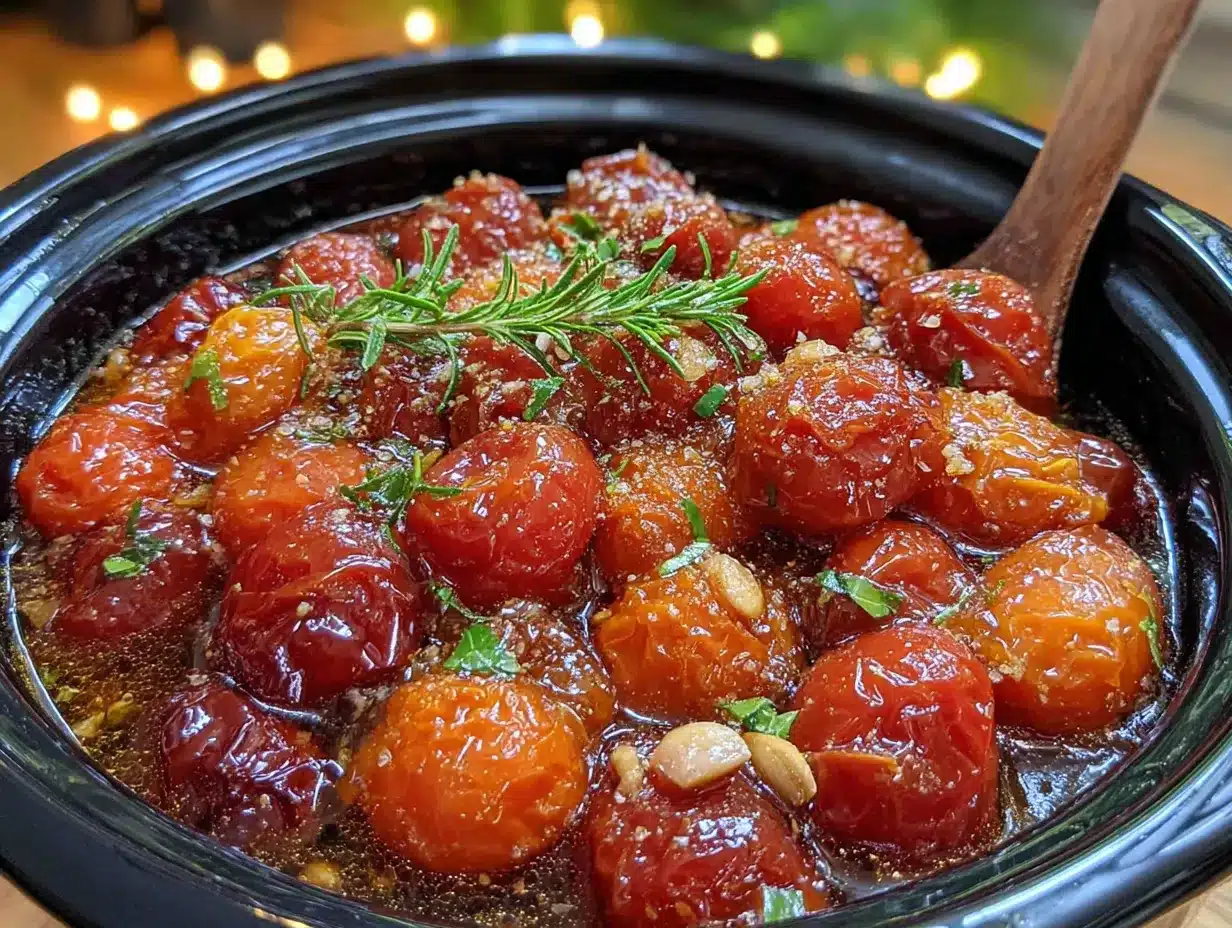
This method breaks down into two main parts: making the confit in the slow cooker, and then canning it for shelf-stable storage. The actual hands-on time is about 30 minutes spread over two days.
Day 1: Make the Confit
- Prepare the tomatoes: Wash and dry the cherry tomatoes thoroughly. Cut each one in half lengthwise. Yes, this takes a while—put on a podcast or call your mom. I usually do this while standing at the counter with a good audiobook going.
- Layer in the slow cooker: Place the halved tomatoes in the slow cooker insert. Tuck the peeled garlic cloves throughout—don’t just dump them on top, or they won’t cook evenly. Add the fresh herb sprigs, salt, and pepper. If using red pepper flakes or bay leaves, add them now.
- Add the olive oil: Pour the olive oil over everything until the tomatoes are barely covered. You don’t need them swimming—just enough that most pieces are submerged. Gently stir once to distribute the oil. The tomatoes will release liquid as they cook, creating a beautiful tomato-infused oil.
- Cook low and slow: Set the slow cooker to LOW and cook for 8 to 10 hours. Do NOT use the HIGH setting—it will overcook the tomatoes and make them mushy. The oil should barely bubble, like a very lazy simmer. I set mine before bed and wake up to the most incredible smell.
- Check for doneness: After 8 hours, the tomatoes should be slightly wrinkled but still holding their shape. The garlic should be soft enough to mash with a fork. If the tomatoes are falling apart, you’ve gone too long—adjust timing next time. Let the confit cool completely in the slow cooker, then transfer to a large bowl, cover, and refrigerate overnight. This resting step allows the flavors to meld and makes the canning process easier the next day.
Day 2: Can the Confit
- Sterilize your jars: Wash jars, lids, and bands in hot soapy water. Place jars in the water bath canner, cover with water, and bring to a boil. Boil for 10 minutes to sterilize. Keep them in hot water until ready to fill. Place lids in a small saucepan of simmering water (not boiling) to soften the sealing compound.
- Reheat the confit: Transfer the cold confit to a large saucepan. Gently warm it over medium-low heat until it’s hot but not simmering—about 180°F (82°C). You want it hot enough to fill jars without cooling them down too much, but not so hot that the oil starts to bubble aggressively.
- Prepare the lemon juice: Add 2 tablespoons of bottled lemon juice to each clean, hot pint jar. This acidifies the tomatoes for safe canning. I use a small measuring cup for this to keep it precise.
- Fill the jars: Using your funnel and ladle, carefully fill each jar with the warm confit. Leave ½ inch of headspace at the top. Use a chopstick or bubble remover tool to gently release any air bubbles trapped between the tomatoes. Wipe the jar rims with a clean, damp towel—any oil residue will prevent a proper seal.
- Apply lids and bands: Center a lid on each jar and screw the band on until fingertip-tight. Don’t overtighten—air needs to escape during processing.
- Process in water bath: Place filled jars in the canner rack, ensuring they’re covered by at least 2 inches of water. Bring to a full rolling boil, then process for 15 minutes (adjust for altitude—add 5 minutes for every 1,000 feet above sea level). Turn off the heat and let jars sit in the water for 5 minutes before removing.
- Cool and check seals: Carefully lift jars out and place them on a clean towel. Let them cool undisturbed for 12 to 24 hours. You’ll hear the satisfying “ping” of lids sealing as they cool. Press the center of each lid—if it doesn’t flex, the jar is sealed. Any unsealed jars should be refrigerated and used within 2 weeks.
Cooking Tips & Techniques
After making this recipe more times than I can count, I’ve collected a few hard-won lessons that’ll save you from my mistakes.
Don’t rush the slow cooker. I learned this the hard way when I tried cooking on HIGH for 4 hours because I forgot to start it the night before. The tomatoes turned into a sad, mushy paste, and the garlic was still crunchy in the middle. LOW for 8 to 10 hours is non-negotiable—the gentle heat is what creates that silky, concentrated texture.
Watch your oil level. Different slow cookers have different hot spots. If your model runs hot around the edges, the oil might bubble more aggressively, and you could lose some to evaporation. I keep a small measuring cup of extra oil nearby and add a splash if the tomatoes start looking exposed halfway through cooking.
Use bottled lemon juice for canning, not fresh. I know, I know—fresh lemon juice tastes better. But for canning, you need the consistent acidity of bottled juice (usually around 5% acidity). Fresh lemons vary too much, and that inconsistency can make your canned goods unsafe. Save the fresh lemons for the jar you plan to eat right away.
Multitask strategically. While the confit is reheating on day 2, get your water bath canner boiling and your jars sterilizing. The whole canning process moves quickly once you start filling jars, so having everything ready beforehand makes it much less stressful.
Label your jars. I write the date and contents on the lid with a permanent marker. You’d be surprised how similar confit looks to other canned goods after a few months in the pantry. I once accidentally opened a jar of pickled beets thinking it was tomato confit—don’t be me.
Variations & Adaptations
One of the best things about this confit is how easy it is to customize. Here are some variations I’ve tried and loved:
Spicy Confit: Add 2 to 3 dried chili peppers (like arbol or cayenne) along with the herbs. The heat infuses into the oil without making it overpowering. I made a batch with habanero once, and it was incredible on eggs—but definitely not for the faint of heart.
Herb Garden Medley: Swap the thyme and rosemary for whatever you have growing. Basil, oregano, marjoram, and even a few sage leaves work beautifully. Just be careful with strong herbs like sage—a little goes a long way.
Garlic Lover’s Version: Double the garlic cloves. Yes, really. The confit garlic becomes so sweet and mellow that you’ll find yourself eating it straight from the jar (no judgment here). I’ve added up to 25 cloves in a batch, and it was divine.
Low-Sodium Option: Reduce the salt to 1 teaspoon or omit it entirely. The tomatoes and herbs provide plenty of flavor on their own. Just note that salt does help with preservation, so these jars won’t last quite as long in the pantry (use within 6 months instead of 12).
Balsamic Twist: Add 2 tablespoons of balsamic vinegar to the slow cooker along with the oil. It adds a subtle sweetness and depth that’s incredible on crusty bread. This variation is my personal favorite for holiday gifts.
Serving & Storage Suggestions
This confit is incredibly versatile, and I love finding new ways to use it. Here are my favorites:
Serving Ideas: Spoon the confit over warm goat cheese and serve with crostini for an instant appetizer. Toss it with hot pasta and a handful of fresh basil for a 10-minute dinner. Spread the confit garlic on crusty bread and top with the tomatoes for a simple bruschetta. Use it as a pizza topping instead of sauce—trust me on this one. Drizzle the infused oil over roasted vegetables or grilled fish for an instant flavor boost.
Storage: Sealed jars of properly canned confit will keep in a cool, dark pantry for up to 12 months. Once opened, refrigerate and use within 2 weeks. The oil may solidify in the fridge—just let it sit at room temperature for 15 minutes, and it’ll return to liquid. I’ve found that the flavor actually improves after about a month of storage, as the garlic and herbs continue to infuse the oil.
Reheating: For best results, warm the confit gently in a small saucepan over low heat. Don’t microwave it—the oil can heat unevenly and spatter. If you’re using it cold on salads or sandwiches, just spoon it straight from the jar.
Gift Giving: These jars make wonderful homemade gifts. I tie a ribbon around the neck and attach a tag with serving suggestions. They’re always the first thing to disappear at holiday cookie exchanges.
Nutritional Information & Benefits
While this confit is definitely an indulgence (it is made with olive oil, after all), it also packs some surprising nutritional benefits.
Per serving (2 tablespoons): Approximately 90 calories, 9g fat (1g saturated), 2g carbohydrates, 0g protein, 1g fiber. These values are estimates and will vary based on the exact ingredients and oil absorption.
Key Benefits: Cherry tomatoes are rich in lycopene, a powerful antioxidant that’s actually more bioavailable when cooked. The olive oil provides heart-healthy monounsaturated fats, and garlic is known for its anti-inflammatory properties. The slow cooking process concentrates these nutrients without destroying them, making this confit a delicious way to add more vegetables to your diet.
Dietary Considerations: This recipe is naturally gluten-free, dairy-free, vegan, and paleo-friendly. It’s also Whole30-compliant if you skip the optional balsamic vinegar. The only potential allergen is the olive oil itself, which is generally well-tolerated.
My Personal Take: I don’t believe in labeling foods as “good” or “bad.” This confit is a treat, yes, but it’s also a way to preserve summer’s bounty and enjoy vegetables in a deeply satisfying way. A little bit goes a long way, and I’d rather have a spoonful of this on my pasta than a processed sauce any day.
Conclusion
This slow cooker cherry tomato garlic confit has become my most-requested recipe, and for good reason. It captures the essence of summer in a jar—sweet, savory, and deeply satisfying—with almost no active effort on your part. Whether you’re staring down a mountain of garden tomatoes or just want to stock your pantry with something special, this recipe delivers every single time.
I’d love to hear how it turns out for you. Did you add your own twist? Use it in a surprising way? Leave a comment below and tell me about it—I read every single one, and your ideas often inspire my next batch. And if you’re feeling generous, share this recipe with a friend who loves tomatoes as much as we do.
Here’s to lazy summer days, full pantries, and the magic of slow cooking. Happy canning, friend.
Frequently Asked Questions
Can I use regular tomatoes instead of cherry tomatoes?
You can, but the texture will be different. Larger tomatoes contain more water and will break down more during the long cooking time, resulting in a saucier confit rather than intact pieces. If using regular tomatoes, cut them into 1-inch chunks and expect a more rustic result. It’s still delicious—just different.
Do I really need to can this, or can I just refrigerate it?
Absolutely you can skip the canning and just refrigerate the confit! It will keep in an airtight container in the fridge for up to 3 weeks. The canning process is only necessary if you want shelf-stable jars that don’t require refrigeration. I often make a small batch just for the fridge and can the rest.
Why did my confit turn brown?
This usually happens if the slow cooker temperature is too high or the cooking time is too long. The natural sugars in the tomatoes can caramelize and darken, which isn’t harmful but does change the flavor slightly. Next time, check your slow cooker’s temperature with a thermometer and aim for around 200°F (93°C) on the LOW setting.
Can I use this confit in place of tomato sauce in recipes?
Yes, but with adjustments. The confit is oil-based, so you’ll want to use less oil in the rest of the recipe. I often use it as a base for pasta sauces, soups, and stews—just add it at the beginning and let it melt into the dish. It works particularly well in recipes that call for both oil and tomatoes.
How do I know if my jars are sealed properly?
After the jars cool completely (12 to 24 hours), press the center of each lid. If it’s firm and doesn’t flex or pop, it’s sealed. You can also remove the band and gently lift the jar by the lid—if the lid holds, it’s sealed. Any jars that didn’t seal should be refrigerated and used within 2 weeks, or you can reprocess them with new lids within 24 hours.
Pin This Recipe!
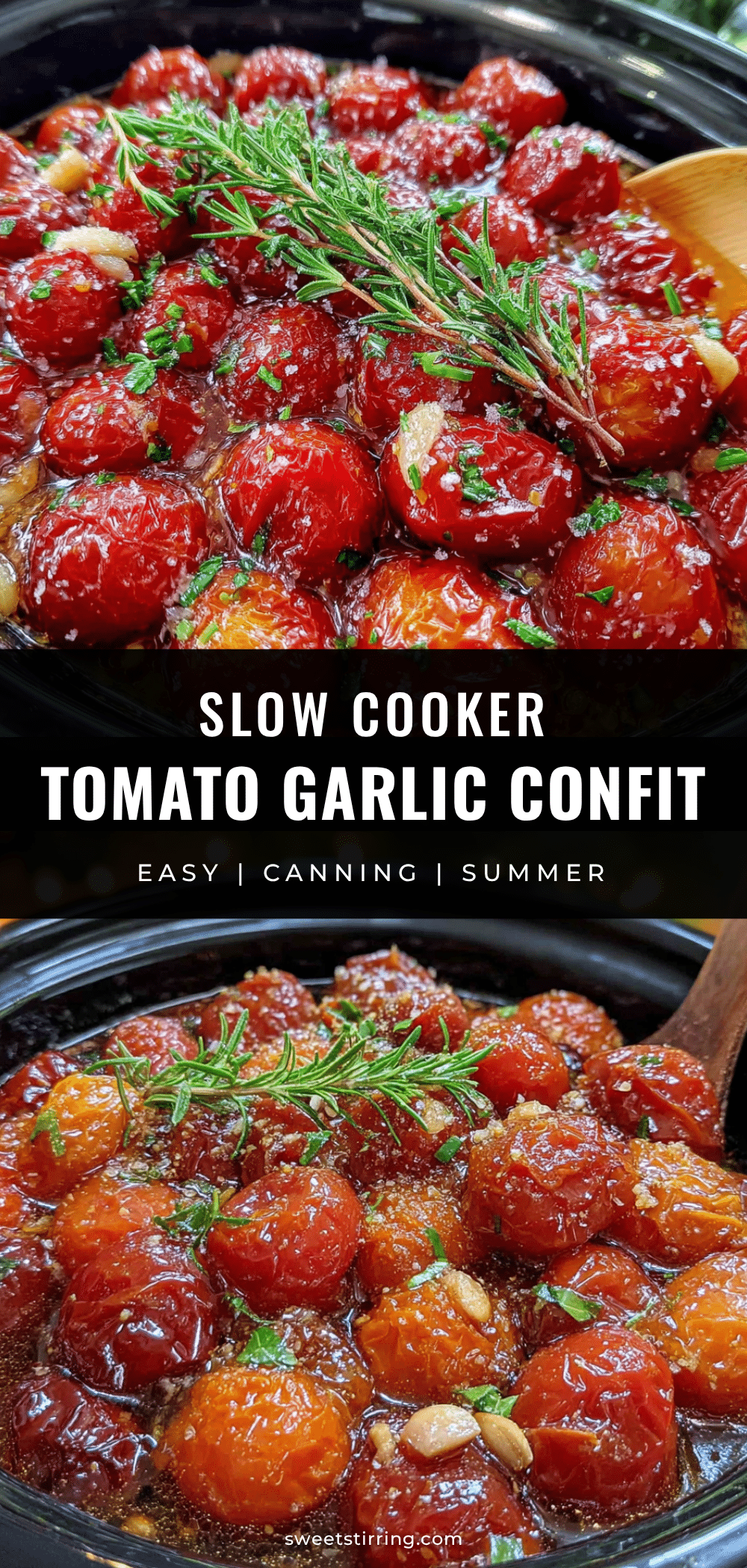
Best Slow Cooker Cherry Tomato Garlic Confit for Easy Canning

This slow cooker cherry tomato garlic confit captures the essence of summer in a jar with minimal effort. Perfect for canning, it yields sweet, savory tomatoes and mellow garlic infused with herbs, ready to brighten any dish year-round.
- Prep Time: 30 minutes
- Cook Time: 8 hours 30 minutes
- Total Time: 1 day 9 hours
- Yield: 5 to 6 pint jars 1x
- Category: Preserves
- Cuisine: American
Ingredients
- 4 pounds (about 1.8 kg) cherry tomatoes, washed and halved
- 12 to 15 large garlic cloves, peeled
- 2 to 2 ½ cups (480 to 600 ml) extra virgin olive oil
- 6 sprigs fresh thyme (or 1 teaspoon dried)
- 4 sprigs fresh rosemary (or 1 teaspoon dried)
- 1 ½ teaspoons kosher salt (preferably Diamond Crystal)
- ½ teaspoon freshly cracked black pepper
- 2 tablespoons bottled lemon juice per pint jar
- Optional: 2 bay leaves, ½ teaspoon red pepper flakes, 2 strips lemon zest
Instructions
- Day 1: Make the Confit. Wash and dry cherry tomatoes, then cut each in half lengthwise.
- Layer halved tomatoes in a 6-quart or larger slow cooker. Tuck peeled garlic cloves throughout. Add fresh herb sprigs, salt, and pepper. Add optional bay leaves or red pepper flakes if using.
- Pour olive oil over tomatoes until barely covered. Gently stir once to distribute oil.
- Set slow cooker to LOW and cook for 8 to 10 hours. Do not use HIGH setting.
- After 8 hours, check for doneness: tomatoes should be slightly wrinkled but holding shape; garlic should be soft enough to mash with a fork. Let cool completely in slow cooker, then transfer to a large bowl, cover, and refrigerate overnight.
- Day 2: Can the Confit. Sterilize jars, lids, and bands in hot soapy water. Place jars in water bath canner, cover with water, and boil for 10 minutes. Keep jars hot until filling. Place lids in simmering water to soften sealing compound.
- Transfer cold confit to a large saucepan. Gently warm over medium-low heat until hot but not simmering (about 180°F/82°C).
- Add 2 tablespoons bottled lemon juice to each clean, hot pint jar.
- Using a funnel and ladle, fill each jar with warm confit, leaving ½ inch headspace. Use a chopstick or bubble remover to release air bubbles. Wipe jar rims with a clean, damp towel.
- Center a lid on each jar and screw band on until fingertip-tight.
- Place filled jars in canner rack, ensuring they are covered by at least 2 inches of water. Bring to a full rolling boil, then process for 15 minutes (adjust for altitude: add 5 minutes per 1,000 feet above sea level). Turn off heat and let jars sit in water for 5 minutes before removing.
- Carefully lift jars out and place on a clean towel. Cool undisturbed for 12 to 24 hours. Check seals: press center of lid; if it doesn’t flex, jar is sealed. Refrigerate any unsealed jars and use within 2 weeks.
Notes
Do not rush the slow cooker; LOW for 8-10 hours is essential for proper texture. Use bottled lemon juice for canning to ensure consistent acidity. Label jars with date and contents. Sealed jars keep in a cool, dark pantry for up to 12 months; once opened, refrigerate and use within 2 weeks. The oil may solidify in the fridge; let sit at room temperature for 15 minutes to return to liquid.
Nutrition
- Serving Size: 2 tablespoons
- Calories: 90
- Fat: 9
- Saturated Fat: 1
- Carbohydrates: 2
- Fiber: 1
Keywords: slow cooker cherry tomato confit, tomato garlic confit, easy canning, cherry tomato preserve, homemade confit, summer tomato recipe, water bath canning