Love this? Save it for later!
Share the inspiration with your friends
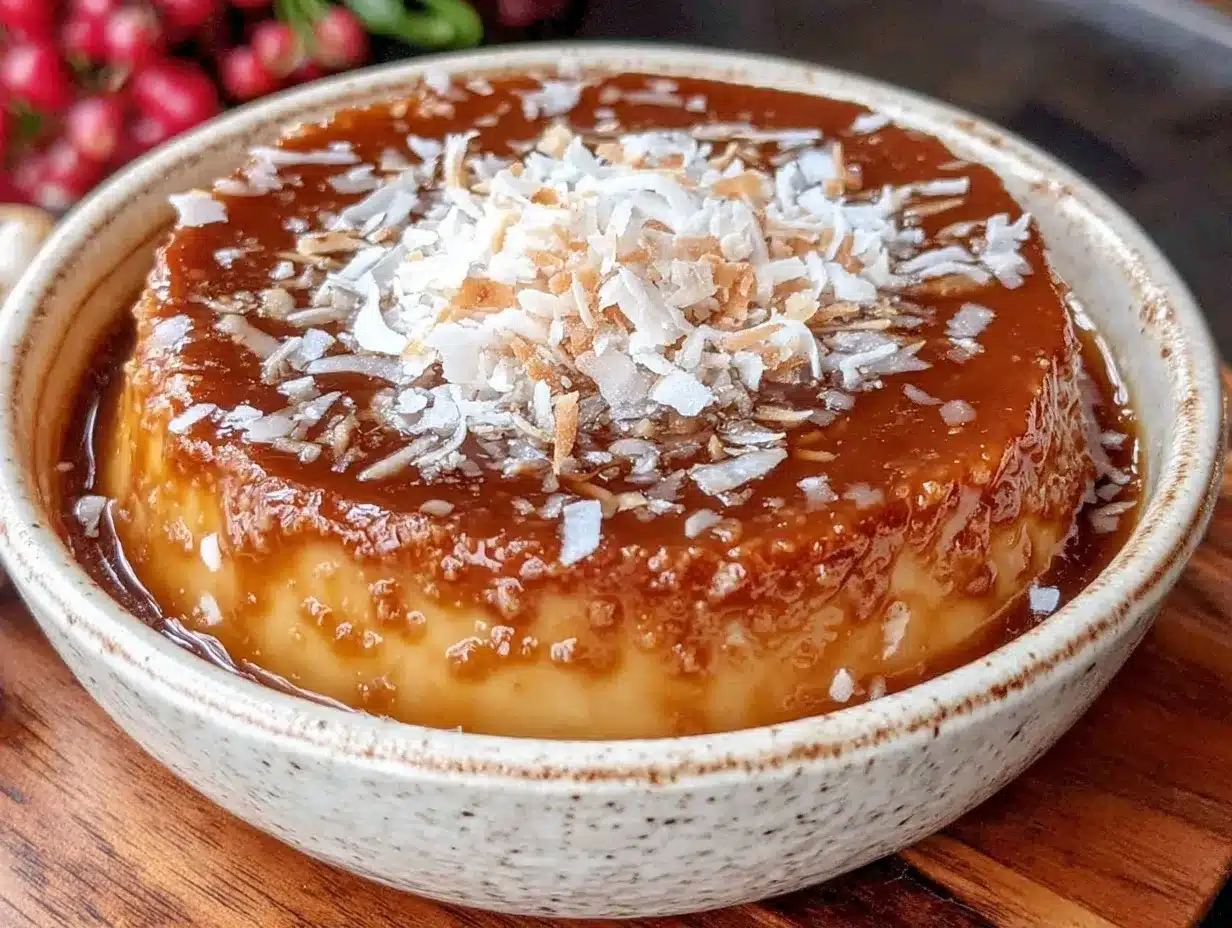
“You have to try this,” my neighbor Anura said one humid Saturday afternoon, holding out a small, slightly cracked bowl with a shy smile. I wasn’t expecting much, honestly—just another sweet I’d nibble on politely. But the moment I took that first spoonful of the creamy Sri Lankan Watalappan coconut jaggery custard, I was hooked. It was like the warmth of a tropical sunset wrapped in a velvety texture, with hints of cardamom and a deep, caramel-like richness from jaggery I hadn’t quite tasted before.
That unexpected afternoon marked the start of my obsession with this unique custard dessert. Watalappan isn’t just a recipe; it’s a story of blending cultures and simple ingredients into something truly soulful. Anura, who grew up in Colombo, shared how this dish was a staple at celebrations and family gatherings, yet somehow, it felt intimate and personal—like a sweet secret passed down through generations.
Maybe you’ve been there, savoring a bite that transports you somewhere far away or reminds you of something you didn’t even know you missed. For me, Watalappan is exactly that kind of comfort food. It’s creamy, just sweet enough, and carries this lovely, earthy depth from jaggery and coconut milk that you don’t find in typical custards. I can’t wait to share this easy homemade recipe with you, so you can bring a little Sri Lankan magic to your kitchen—no need for fancy ingredients or complicated techniques, just honest flavor and a touch of tradition.
Why You’ll Love This Recipe
This creamy Sri Lankan Watalappan coconut jaggery custard has been tested thoroughly in my kitchen (and Anura’s too!), so you’re getting a recipe that’s both authentic and foolproof. Let me tell you why it stands out:
- Quick & Easy: Ready in just about 45 minutes, perfect for when you want a special dessert without the fuss.
- Simple Ingredients: No exotic shopping necessary — pantry staples like coconut milk and jaggery do all the heavy lifting.
- Perfect for Celebrations: Whether it’s a holiday feast or a casual dinner, Watalappan adds a sweet, cozy finish.
- Crowd-Pleaser: It’s the kind of dessert that wins over skeptics and kids alike with its smooth texture and warm spices.
- Unbelievably Delicious: The blend of coconut and jaggery creates a flavor depth you won’t find in your average custard.
This isn’t just another custard recipe. The secret is in the jaggery—a natural sweetener that gives it that rich, molasses-like undertone. Plus, the subtle cardamom and nutmeg bring a fragrant complexity that balances the sweetness beautifully. Honestly, after making this a few times, I realized it’s the kind of dessert you’ll want to revisit again and again, whether for cozy weeknights or to impress guests effortlessly.
What Ingredients You Will Need
This recipe uses simple, wholesome ingredients to deliver bold flavor and satisfying texture without the fuss. Most of these are pantry staples or easy to find at your local grocery store or Asian market.
- Jaggery (palm jaggery or coconut jaggery), grated or chopped – The star sweetener, providing a deep caramel flavor (substitute with dark brown sugar if unavailable, but it won’t be quite the same).
- Coconut milk, full-fat – Adds richness and creamy texture (I prefer Aroy-D brand for its smoothness).
- Eggs, large – The base for the custard, room temperature for best results.
- Cardamom powder – About 1 teaspoon, freshly ground if possible, for that warm aroma.
- Nutmeg, freshly grated – Just a pinch to enhance the spice profile.
- Vanilla extract – 1 teaspoon, optional but recommended for a subtle sweetness and depth.
- Pandan leaves or bay leaves – Optional, for a subtle herbal note (tie into a knot for easy removal).
- Salt – Just a pinch to balance the sweetness.
- Water – A small amount to help dissolve the jaggery.
If you want to try a twist, swapping coconut milk with almond milk is possible but will change the flavor. For a vegan adaptation, substitute eggs with silken tofu blended smooth, but expect a different texture.
Equipment Needed
- Mixing bowls: For beating eggs and mixing ingredients.
- Whisk or fork: To combine the custard mixture smoothly.
- Small saucepan: To melt and dissolve the jaggery gently.
- Steaming setup: Either a steamer basket over a pot or a heatproof dish for water bath (bain-marie) in the oven.
- Oven-safe ramekins or a medium-sized baking dish: For setting the custard.
- Measuring cups and spoons: For accurate ingredient amounts.
If you don’t have a steamer, a water bath in the oven works perfectly—just make sure to cover the custard with foil to prevent water droplets on top. I often use my trusty bamboo steamer lined with banana leaves when I want that authentic touch and subtle aroma. For budget-friendly options, any heatproof bowl and a large pot with a lid to create a makeshift steam setup will do.
Preparation Method
- Prepare the jaggery syrup: In a small saucepan, combine the grated jaggery with ¼ cup (60 ml) of water. Heat gently over medium-low flame, stirring occasionally until fully melted and smooth. Avoid boiling aggressively to prevent bitterness. This should take about 5–7 minutes. Set aside to cool slightly.
- Mix the custard base: In a large bowl, whisk together 4 large eggs until lightly frothy. Gradually pour in 1 cup (240 ml) of full-fat coconut milk while whisking gently to combine.
- Add flavorings: Stir in 1 teaspoon of cardamom powder, a pinch of freshly grated nutmeg, 1 teaspoon vanilla extract, and a pinch of salt. If using pandan leaves, add the tied leaves now to infuse flavor.
- Combine jaggery syrup: Slowly drizzle the cooled jaggery syrup into the egg and coconut mixture, whisking constantly to prevent cooking the eggs. The mixture should be smooth and velvety.
- Strain the custard: For an ultra-smooth texture, strain the mixture through a fine sieve into another bowl to remove any lumps or bits of coagulated egg.
- Prepare for steaming: Pour the custard into lightly greased ramekins or a single baking dish. Place these in your steamer or into a water bath setup in the oven.
- Steam the custard: Cover loosely with foil to prevent condensation from dripping on top. Steam over simmering water for 25–30 minutes or bake in a preheated oven at 320°F (160°C) in a water bath for 30–35 minutes. The custard should be just set but still slightly wobbly in the center.
- Cool and serve: Remove from heat and allow to cool completely. Chill in the fridge for at least 2 hours before serving to let flavors meld and texture firm up.
Pro tip: If you notice any bubbles on the surface after steaming, gently tap the ramekins to smooth them out. Also, keep an eye on the water level in your steamer or water bath to avoid dry heating, which can crack the custard. I once forgot the water check and ended up with a slightly cracked top, but honestly, it tasted just as good!
Cooking Tips & Techniques
Cooking Watalappan is all about gentle heat and patience. Here are some tips I’ve learned along the way:
- Use low heat when melting jaggery: High heat can scorch it, leading to a bitter taste.
- Whisk eggs lightly: Over-beating incorporates air, which might cause cracks or bubbles in the custard.
- Strain the mixture: This step ensures the custard is silky smooth, free of any curdled bits.
- Cover while steaming or baking: Foil prevents water droplets from spoiling the custard’s surface.
- Don’t overcook: The custard should still jiggle slightly when done; it will firm up as it cools.
- Multitasking tip: While the custard is steaming, you can prepare a simple garnish like toasted coconut flakes or crushed cashews for a lovely crunch contrast.
One cooking fail I remember well: I once added jaggery straight into hot coconut milk without melting it first, and the lumps ruined the smoothness. Lesson learned! Melting jaggery fully beforehand makes all the difference.
Variations & Adaptations
This recipe is flexible and welcomes a few fun twists:
- Vegan version: Substitute eggs with blended silken tofu or a mix of chickpea flour and water for a similar custard texture.
- Spice it up: Add a pinch of cinnamon or cloves for a festive touch, especially around the holidays.
- Nutty crunch: Sprinkle toasted cashews, pistachios, or coconut flakes on top before serving.
- Fruit infusion: Incorporate finely chopped ripe mango or banana into the custard before steaming for a tropical twist.
- Low-sugar: Reduce jaggery slightly and add a splash of natural vanilla for sweetness without overdoing it.
Personally, I once swapped jaggery with muscovado sugar when I ran out—it worked fine but lacked the unique depth. For a true taste of Sri Lanka, stick with authentic jaggery if you can find it.
Serving & Storage Suggestions
Watalappan is best served chilled, straight from the refrigerator. The creamy, cool custard is perfect as is, but if you want to get fancy, try these:
- Top with toasted coconut flakes or a sprinkle of crushed nuts for texture contrast.
- Serve alongside fresh tropical fruit like pineapple, mango, or papaya for a fresh bite.
- A cup of strong black tea or spiced chai pairs beautifully with the warm spices in the custard.
To store, keep Watalappan covered in the fridge for up to 3 days. It holds well without losing moisture. If you want to save it longer, wrap tightly and freeze for up to a month—just thaw overnight in the fridge before serving.
Reheating isn’t usually recommended since the texture can change, but if you prefer it warm, gently steam or microwave in short bursts while stirring.
Nutritional Information & Benefits
A typical serving of this creamy Sri Lankan Watalappan provides about 250 calories, mainly from natural fats in coconut milk and sugars from jaggery. Jaggery is less refined than white sugar and retains some minerals like iron and potassium, making it a slightly healthier sweetener.
Coconut milk brings healthy fats that support energy and satiety, while the warming spices like cardamom and nutmeg are known for their antioxidant properties and digestive benefits. This dessert is naturally gluten-free and can be adapted for vegan diets, making it accessible for many dietary needs.
Keep in mind, while this custard is a treat, its wholesome ingredients make it a satisfying indulgence without the artificial additives.
Conclusion
This creamy Sri Lankan Watalappan coconut jaggery custard is a recipe that truly stays with you. It’s simple to make, rich in flavor, and carries a bit of history and soul in every bite. Whether you’re new to Sri Lankan cuisine or craving something comfortingly different, this dessert welcomes you warmly.
Feel free to tweak it to suit your tastes—maybe more cardamom, less sugar, or a nutty topping. The best part? It’s forgiving and always delicious. I love how this recipe brings a little tropical sunshine to my kitchen, and I hope it does the same for you.
Let me know how your Watalappan turns out or if you’ve tried any fun twists. Sharing your cooking stories keeps this tradition alive and thriving!
FAQs
What is jaggery, and can I substitute it?
Jaggery is an unrefined natural sweetener made from palm or sugarcane juice. It has a deep caramel flavor unlike white sugar. You can substitute dark brown sugar, but the taste won’t be as rich.
Can I make Watalappan without eggs?
Yes! For a vegan version, use blended silken tofu or chickpea flour mixed with water as an egg substitute, though the texture will be slightly different.
How do I know when Watalappan is fully cooked?
The custard should be just set with a slight wobble in the center. Overcooking makes it rubbery, so check at 25 minutes and test gently with a toothpick.
Can I prepare Watalappan ahead of time?
Absolutely! It tastes even better chilled after a few hours or overnight. Store covered in the fridge for up to 3 days.
What’s the best way to serve Watalappan?
Serve chilled with a sprinkle of toasted coconut or nuts on top. It pairs wonderfully with fresh tropical fruits or a warm cup of spiced tea.
Pin This Recipe!
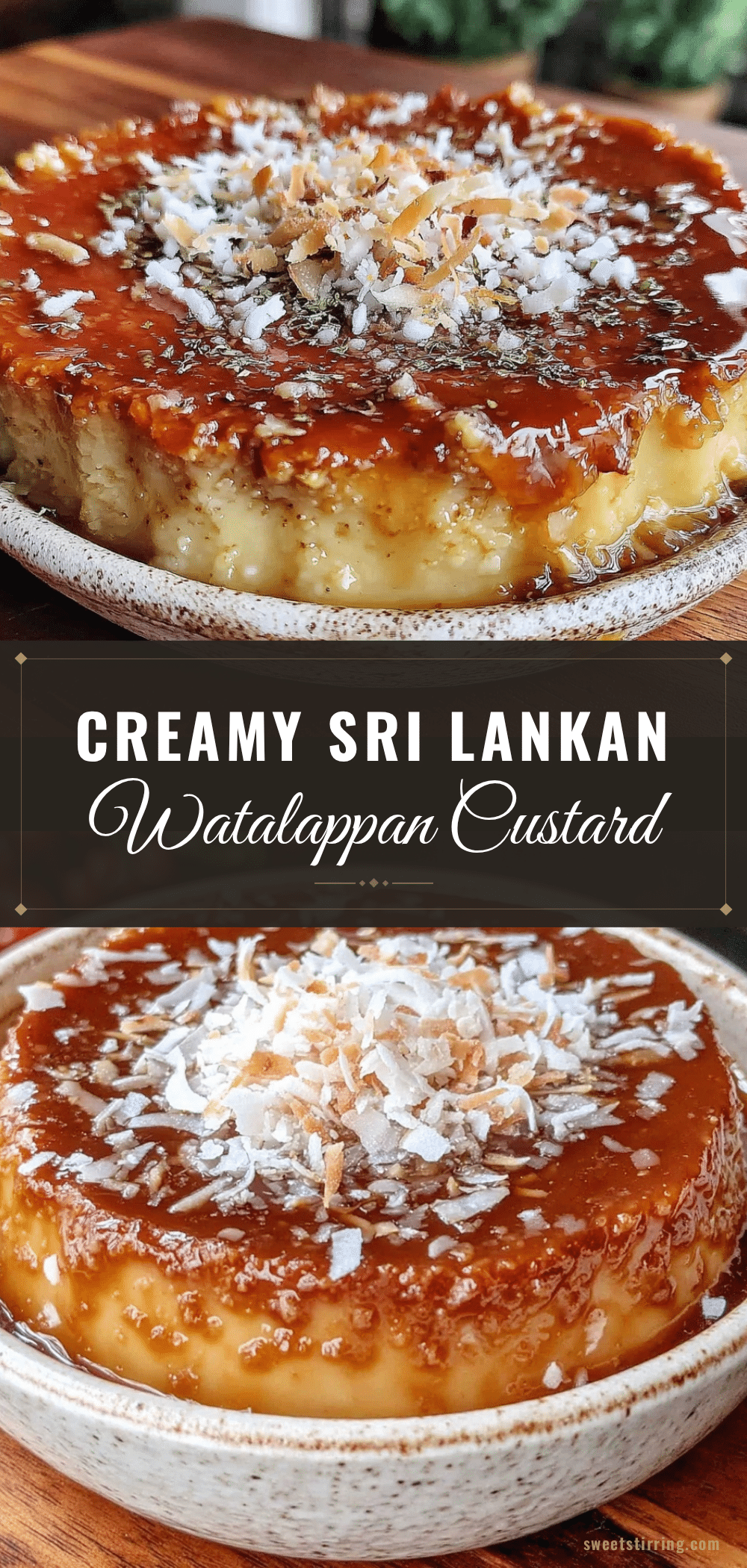
Creamy Sri Lankan Watalappan Recipe Easy Homemade Coconut Jaggery Custard

A creamy Sri Lankan coconut jaggery custard flavored with cardamom and nutmeg, offering a rich, caramel-like sweetness and smooth texture. This easy homemade dessert is perfect for celebrations or cozy nights.
- Prep Time: 15 minutes
- Cook Time: 30 minutes
- Total Time: 45 minutes
- Yield: 4 servings 1x
- Category: Dessert
- Cuisine: Sri Lankan
Ingredients
- 1 cup grated or chopped jaggery (palm jaggery or coconut jaggery; substitute dark brown sugar if unavailable)
- 1 cup (240 ml) full-fat coconut milk
- 4 large eggs, room temperature
- 1 teaspoon cardamom powder
- Pinch of freshly grated nutmeg
- 1 teaspoon vanilla extract (optional)
- Pandan leaves or bay leaves (optional, tied into a knot)
- Pinch of salt
- 1/4 cup (60 ml) water
Instructions
- In a small saucepan, combine the grated jaggery with 1/4 cup (60 ml) of water. Heat gently over medium-low flame, stirring occasionally until fully melted and smooth, about 5–7 minutes. Avoid boiling aggressively to prevent bitterness. Set aside to cool slightly.
- In a large bowl, whisk together 4 large eggs until lightly frothy. Gradually pour in 1 cup (240 ml) of full-fat coconut milk while whisking gently to combine.
- Stir in 1 teaspoon of cardamom powder, a pinch of freshly grated nutmeg, 1 teaspoon vanilla extract, and a pinch of salt. If using pandan leaves, add the tied leaves now to infuse flavor.
- Slowly drizzle the cooled jaggery syrup into the egg and coconut mixture, whisking constantly to prevent cooking the eggs. The mixture should be smooth and velvety.
- Strain the custard mixture through a fine sieve into another bowl to remove any lumps or bits of coagulated egg for an ultra-smooth texture.
- Pour the custard into lightly greased oven-safe ramekins or a single baking dish. Place these in your steamer or into a water bath setup in the oven.
- Cover loosely with foil to prevent condensation from dripping on top. Steam over simmering water for 25–30 minutes or bake in a preheated oven at 320°F (160°C) in a water bath for 30–35 minutes. The custard should be just set but still slightly wobbly in the center.
- Remove from heat and allow to cool completely. Chill in the fridge for at least 2 hours before serving to let flavors meld and texture firm up.
Notes
Use low heat when melting jaggery to avoid bitterness. Whisk eggs lightly to prevent bubbles or cracks. Strain the custard mixture for a silky smooth texture. Cover with foil while steaming or baking to prevent water droplets on the custard surface. The custard should still jiggle slightly when done and will firm up as it cools. Keep an eye on water level in steamer or water bath to avoid dry heating. For vegan adaptation, substitute eggs with blended silken tofu or chickpea flour mixture, but texture will differ.
Nutrition
- Serving Size: 1 ramekin (approxima
- Calories: 250
- Sugar: 18
- Sodium: 70
- Fat: 18
- Saturated Fat: 15
- Carbohydrates: 20
- Fiber: 1
- Protein: 5
Keywords: Watalappan, Sri Lankan dessert, coconut custard, jaggery custard, cardamom dessert, easy custard recipe, traditional Sri Lankan sweets