Love this? Save it for later!
Share the inspiration with your friends
There used to be a diner on Route 9, the kind with cracked vinyl booths and a jukebox that only played Patsy Cline, that made the best meatloaf I have ever had. When they closed suddenly in 2019—a “for lease” sign taped in the window overnight—I honestly felt a little lost. That sweet, tangy brown sugar glaze, the impossibly tender center, the way the edges got all caramelized and crispy… I spent two years chasing that exact memory. After twelve tries—and one particularly sad loaf that my husband politely called “edible”—I finally cracked the code.
I remember standing in my kitchen last January, staring at a pan of meatloaf that finally looked right. The glaze had that perfect sticky sheen, the top was crackled just like the diner’s, and when I cut into it, the steam smelled like Thursday nights in that booth by the window. I may have actually teared up a little. Maybe you’ve been there—that craving for a dish that feels like a hug from a decade ago, the one you just can’t find anywhere else.
This classic old-fashioned meatloaf with brown sugar glaze is that recipe. It’s the one I keep making, the one my kids now request for their birthdays, the one that makes my neighbor knock on the door asking what’s for dinner. It’s simple, honest, and tastes like something your grandmother might have made—if your grandmother was a short-order cook with a secret weapon.
Why You’ll Love This Recipe
Let’s be real for a second: meatloaf has a reputation problem. Too many people grew up with dry, flavorless bricks of ground meat swimming in ketchup. This is not that meatloaf. This is the meatloaf that changes minds.
I tested this recipe seven times before I got the texture exactly right. I tried different ratios of beef to pork, different binders, different cooking temperatures. My family was very patient, and honestly, they got pretty spoiled. Here is why this version stands out:
- Incredibly Moist & Tender: The secret is a combination of grated onion (which releases moisture as it cooks) and a panade—a paste of breadcrumbs and milk that keeps the meat from getting dense. Every slice stays juicy from edge to center.
- That Brown Sugar Glaze: This is not your average ketchup topping. The brown sugar caramelizes into a sticky, almost candied crust that balances the savory meat perfectly. It’s the part everyone fights over.
- Simple Pantry Ingredients: You probably have 90% of these items in your kitchen right now. No fancy trips to specialty stores, no obscure spices you will never use again.
- Foolproof Method: I have made this on busy weeknights, for Sunday suppers, and even for a potluck where I forgot the serving platter. It works every single time.
- Crowd-Pleaser Approved: My kids call it “candy meatloaf” because of the glaze. My father-in-law, who claims to hate meatloaf, asked for seconds. That is the kind of power this recipe has.
This is comfort food at its finest—the kind that makes you close your eyes after the first bite. It’s nostalgic but not fussy, impressive but not complicated. Whether you are feeding a family or just want leftovers for the next three days, this is the recipe you will come back to again and again.
What Ingredients You Will Need
This recipe uses simple, honest ingredients that work together to create something truly special. Nothing here is complicated, but each component plays a crucial role in building flavor and texture.
- Ground beef (80/20) – 2 pounds. I prefer 80/20 for the perfect balance of flavor and moisture. Too lean, and your meatloaf will be dry. I usually buy from my local butcher, but any good-quality beef works.
- Ground pork – 1/2 pound. This is my secret weapon. The pork adds fat and sweetness that beef alone cannot provide. If you cannot find ground pork, you can use all beef, but trust me on this one.
- Yellow onion – 1 medium, grated. Grating the onion instead of chopping it releases all the juice, which keeps the meatloaf incredibly moist. I use a box grater and catch every drop.
- Garlic – 3 cloves, minced. Fresh garlic is non-negotiable here. The jarred stuff has a different flavor that just does not work as well.
- Breadcrumbs – 1 cup, plain. I use unseasoned panko breadcrumbs for the lightest texture. If you only have seasoned, reduce the salt in the recipe slightly.
- Whole milk – 1/2 cup. This soaks into the breadcrumbs to create a panade, which is the key to a tender meatloaf. Whole milk adds richness that skim milk just cannot match.
- Eggs – 2 large, lightly beaten. Eggs bind everything together. Make sure they are at room temperature so they incorporate smoothly.
- Worcestershire sauce – 2 tablespoons. This adds that deep, umami flavor that makes meatloaf taste like it has been cooking all day. I use Lea & Perrins—it is the only brand I trust.
- Dijon mustard – 1 tablespoon. Do not skip this. The mustard adds a subtle tang that cuts through the richness of the meat.
- Fresh parsley – 2 tablespoons, chopped. A handful of fresh herbs brightens up the whole dish. Dried parsley will work in a pinch, but fresh is better.
- Kosher salt – 1 1/2 teaspoons. I use Diamond Crystal. If you are using table salt, reduce to 1 teaspoon.
- Black pepper – 1 teaspoon, freshly ground. Freshly ground pepper makes a noticeable difference here.
- Dried thyme – 1/2 teaspoon. Thyme and beef are a classic combination. It adds a subtle earthiness that rounds out the flavor.
For the Brown Sugar Glaze:
- Ketchup – 1/2 cup. This is the base of the glaze. I prefer Heinz for its balanced sweetness and tang.
- Brown sugar – 1/4 cup, packed. Light or dark brown sugar both work. Dark brown sugar will give you a deeper, more molasses-like flavor.
- Apple cider vinegar – 1 tablespoon. This cuts the sweetness and adds a little tang. Red wine vinegar works in a pinch.
- Worcestershire sauce – 1 teaspoon. Just a little extra depth for the glaze.
- Garlic powder – 1/4 teaspoon. Not enough to be garlicky, just enough to add complexity.
A note on substitutions: If you need a gluten-free option, use gluten-free breadcrumbs or crushed pork rinds. For a dairy-free version, substitute the milk with unsweetened almond milk or oat milk—just know the texture will be slightly less tender. You can also swap the ground pork for ground turkey, but add a tablespoon of olive oil to keep it moist.
Equipment Needed
You do not need a fancy kitchen to make this meatloaf, but a few key tools make the process much smoother.
- Large mixing bowl – You need room to get your hands in there and mix everything evenly. I use a big ceramic bowl that belonged to my grandmother.
- Box grater – For grating the onion. A food processor with a grating disc works too, but the box grater is easier to clean.
- 9×5-inch loaf pan – This is the standard size for a classic meatloaf. If you do not have one, you can shape the meatloaf free-form on a baking sheet lined with parchment paper.
- Baking sheet – I actually recommend placing the loaf pan on a baking sheet to catch any drips. Trust me, the glaze will bubble over.
- Small bowl – For mixing the glaze. Any small bowl will do.
- Pastry brush – For applying the glaze. A silicone brush is best because it does not shed bristles. If you do not have one, you can use the back of a spoon.
- Meat thermometer – This is non-negotiable for me. An instant-read thermometer takes the guesswork out of cooking and guarantees a perfectly cooked meatloaf every time.
- Cooling rack – Letting the meatloaf rest on a rack allows air to circulate and keeps the bottom from getting soggy.
If you are on a budget, skip the pastry brush and use a spoon. Skip the cooling rack and just let the meatloaf rest on a cutting board. But do not skip the meat thermometer—it is the difference between perfect and dry.
Preparation Method
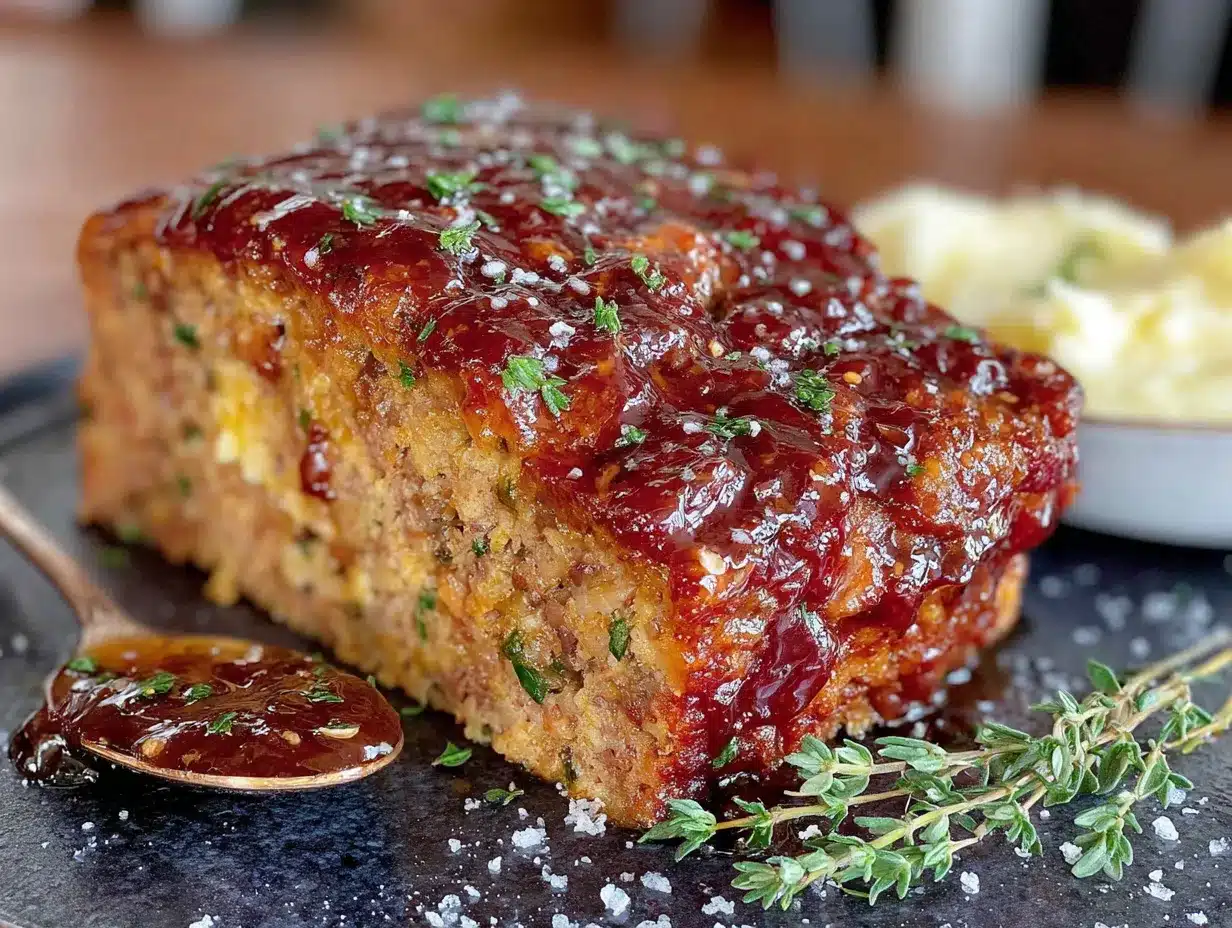
Making this meatloaf is straightforward, but a few small details make all the difference. Follow these steps closely, and you will get that diner-quality result every time.
- Preheat your oven to 350°F (175°C). Position the rack in the center of the oven. While it heats, line a baking sheet with aluminum foil for easy cleanup.
- Make the panade. In your large mixing bowl, combine the breadcrumbs and milk. Stir them together and let them sit for 5 minutes. The breadcrumbs will absorb the milk and turn into a paste. This is the secret to tender meatloaf—it keeps the proteins from tightening up too much as they cook.
- Grate the onion. Using the large holes of your box grater, grate the onion directly over the bowl with the panade. Catch all the juice—that liquid gold is what keeps your meatloaf moist. Add the minced garlic on top.
- Add the wet ingredients. To the bowl, add the beaten eggs, Worcestershire sauce, and Dijon mustard. Whisk everything together until it is well combined. The mixture will look a little loose and that is exactly right.
- Add the seasonings. Sprinkle in the kosher salt, black pepper, dried thyme, and fresh parsley. Stir to distribute evenly.
- Add the meat. Add the ground beef and ground pork to the bowl. Here is the most important step: use your hands to gently mix everything together. Do not overmix. Overworking the meat will make your meatloaf tough. Mix just until everything is combined—about 30 seconds of gentle folding and squeezing. If you see streaks of breadcrumb mixture, that is fine.
- Shape the meatloaf. Lightly grease your loaf pan with a little oil or cooking spray. Transfer the meat mixture to the pan and press it gently into an even loaf shape. Do not pack it down hard—just smooth the top with your hands. Place the loaf pan on the prepared baking sheet.
- Make the glaze. In a small bowl, whisk together the ketchup, packed brown sugar, apple cider vinegar, Worcestershire sauce, and garlic powder until smooth. The mixture should be thick but spreadable.
- Apply the first layer of glaze. Using your pastry brush or the back of a spoon, spread about half of the glaze evenly over the top of the meatloaf. Reserve the remaining glaze for later.
- Bake for 45 minutes. Place the meatloaf in the oven and bake for 45 minutes. The glaze will start to caramelize and the kitchen will smell incredible.
- Apply the second layer. After 45 minutes, carefully remove the meatloaf from the oven. Spread the remaining glaze over the top. Return to the oven and bake for another 15 to 20 minutes.
- Check the temperature. The meatloaf is done when an instant-read thermometer inserted into the center reads 160°F (71°C). This is the safe internal temperature for ground meat. If you do not have a thermometer, cut into the center—the juices should run clear and there should be no pinkness.
- Rest before slicing. Remove the meatloaf from the oven and let it rest in the pan for 10 minutes. This is crucial. The resting time allows the juices to redistribute throughout the loaf. If you cut into it too soon, it will crumble. After 10 minutes, carefully transfer the meatloaf to a cutting board.
- Slice and serve. Use a sharp knife to cut thick slices—about 1 inch each. The glaze will be sticky and gorgeous. Serve immediately.
A quick note on timing: The total cooking time is about 60 to 65 minutes, plus 10 minutes of resting. Start checking the temperature at the 55-minute mark if your oven runs hot. I have a gas oven that runs a little cool, so mine usually needs the full 65 minutes.
Cooking Tips & Techniques
Over the course of those twelve test loaves, I learned a few things the hard way. Let me save you the trouble.
The biggest mistake people make is overmixing. I did it myself on attempt number three. I wanted to make sure everything was perfectly combined, so I kept kneading and folding. The result was a meatloaf that could have doubled as a hockey puck. Mix gently, with your hands, and stop as soon as everything comes together. A few streaks are fine.
Do not skip the panade. I know it seems like an extra step, but the breadcrumb-and-milk paste is what keeps the meatloaf from drying out. Without it, the proteins in the meat tighten up and squeeze out all the moisture. I tried making this recipe without the panade once, just to see, and the result was dry and crumbly. Never again.
Grate, do not chop, the onion. Chopped onion releases some moisture, but grated onion releases all of it. Plus, grated onion melts into the meatloaf as it cooks, so you get the flavor without any crunchy bits of raw onion. My kids have no idea there is onion in this, and I am not telling them.
Let the meatloaf rest. I know you are hungry. I know it smells amazing. But if you slice into that meatloaf right out of the oven, it will fall apart. The resting time lets the juices settle and the structure firm up. Ten minutes is not that long. Use that time to make a salad or set the table.
Use a meat thermometer. I used to eyebit it, and I ended up with either dry meatloaf or undercooked meatloaf. An instant-read thermometer takes all the guesswork out. And honestly, it is the only way to be sure you have hit that perfect 160°F.
Line your baking sheet. The glaze will bubble over the sides of the loaf pan. If you put the pan directly on the oven rack, you will have a sticky, burnt mess to clean up. A lined baking sheet catches everything and makes cleanup a breeze.
Variations & Adaptations
One of the best things about this recipe is how adaptable it is. Here are a few ways I have changed it up over the years.
Turkey Meatloaf: Swap the ground beef and pork for 2 1/2 pounds of ground turkey (93/7 works best). Add 2 tablespoons of olive oil to the mixture to compensate for the lower fat content. The cooking time stays about the same, but check the temperature at 50 minutes. Turkey meatloaf is a little leaner, but the glaze makes up for it.
Cheesy Stuffed Meatloaf: This is my husband’s favorite variation. After mixing the meat, press half of it into the loaf pan. Make a shallow well down the center and fill it with 1 cup of shredded cheddar cheese or mozzarella. Top with the remaining meat mixture, sealing the edges. Bake as directed. The cheese melts into a gooey, stretchy center that is absolutely ridiculous.
BBQ Meatloaf: Replace the ketchup in the glaze with your favorite barbecue sauce. I use a smoky chipotle BBQ sauce for a little heat. Reduce the brown sugar to 2 tablespoons since most BBQ sauces are already sweet. This version is perfect for summer cookouts—serve it with coleslaw and cornbread.
Gluten-Free Option: Substitute the breadcrumbs with gluten-free breadcrumbs or crushed pork rinds. The pork rinds actually add a nice richness. Use tamari instead of Worcestershire sauce (or check that your Worcestershire is gluten-free). The texture will be slightly different, but still delicious.
Spicy Kick: Add 1 teaspoon of smoked paprika and 1/2 teaspoon of cayenne pepper to the meat mixture. For the glaze, stir in a tablespoon of sriracha or your favorite hot sauce. The sweetness of the brown sugar balances the heat beautifully.
I once made a version with diced jalapeños and pepper jack cheese for a game day party. It disappeared in about ten minutes. People were standing around the kitchen island eating it straight off the cutting board.
Serving & Storage Suggestions
This meatloaf is a meal in itself, but a few sides really make it shine. I like to serve it with mashed potatoes—the gravy from the meatloaf mixed with the potatoes is pure comfort. A simple green salad with a tangy vinaigrette cuts through the richness, and roasted green beans or steamed broccoli round out the plate.
For a truly nostalgic diner experience, serve it with a side of buttered egg noodles or macaroni and cheese. And do not forget the bread—a slice of crusty white bread to wipe up every last bit of glaze from the plate. That might be my favorite part.
Storage: Leftover meatloaf keeps beautifully. Let it cool completely, then wrap it tightly in plastic wrap or aluminum foil, or store it in an airtight container. It will keep in the refrigerator for up to 4 days. The flavors actually meld together overnight, so leftovers might taste even better than the first meal.
Freezing: This meatloaf freezes wonderfully. I often make a double batch and freeze one for later. Wrap the cooled, unsliced meatloaf tightly in plastic wrap, then a layer of aluminum foil. It will keep in the freezer for up to 3 months. To thaw, transfer it to the refrigerator overnight.
Reheating: The best way to reheat meatloaf is in the oven. Place slices on a baking sheet and warm them at 300°F (150°C) for about 10 minutes. This keeps the glaze sticky and the meat moist. You can use the microwave in a pinch, but the glaze will get soft and the texture will not be as good.
One thing I love about this recipe is how the flavors develop. The second day, the meatloaf is even more savory, and the glaze has soaked into the edges a little more. I often make it a day ahead on purpose.
Nutritional Information & Benefits
I am not a nutritionist, but I can give you a rough estimate based on a standard serving size of one slice (about 1/8 of the loaf).
| Nutrient | Amount Per Serving |
|---|---|
| Calories | 385 |
| Protein | 28g |
| Fat | 22g |
| Saturated Fat | 8g |
| Carbohydrates | 18g |
| Fiber | 1g |
| Sugar | 11g |
| Sodium | 680mg |
This recipe is a good source of protein and iron from the beef. The onions and garlic provide antioxidants and anti-inflammatory compounds. The brown sugar glaze is the only significant source of added sugar, and you can reduce it by using a sugar substitute if you prefer.
If you are watching your sodium, use low-sodium ketchup and reduce the salt to 1 teaspoon. For a lower-fat option, use ground turkey as suggested in the variations section. This recipe is not exactly health food, but it is real food made with real ingredients—and sometimes that is exactly what you need.
Potential allergens include dairy (milk), eggs, gluten (breadcrumbs), and mustard. Adjust as needed for your dietary requirements.
Conclusion
This classic old-fashioned meatloaf with brown sugar glaze is the recipe I turn to when I need something reliable, comforting, and deeply satisfying. It is the dish that brings my family to the table without being asked twice, the one that makes my kitchen smell like home, the one that reminds me of that little diner on Route 9 and the booth by the window.
I hope you make it your own. Add a little extra garlic if that is your thing. Swap in ground turkey if you are feeling lighter. Stuff it with cheese because why not. The beauty of a recipe like this is that it is a starting point, not a rulebook. Make it once exactly as written, then start playing.
I would love to hear how it turns out for you. Did you try a variation? Did your kids ask for seconds? Did you finally recreate a memory of your own? Drop a comment below and let me know. And if you share it on social media, tag me so I can see your beautiful, glazed, caramelized masterpiece.
Happy cooking, friends. Go make something that feels like a hug.
Frequently Asked Questions
Can I make this meatloaf without a loaf pan?
Absolutely. Shape the meat mixture into a free-form loaf on a parchment-lined baking sheet. The cooking time will be slightly shorter—start checking the temperature at 45 minutes. The edges will get a little more caramelized, which is honestly a bonus.
Why is my meatloaf falling apart?
This usually happens for one of two reasons: either you did not let it rest long enough before slicing, or the mixture was too wet. Make sure you let it rest for a full 10 minutes. If it is still falling apart, try adding an extra egg or a few more breadcrumbs next time.
Can I use steel-cut oats instead of breadcrumbs?
Yes, but use quick-cooking oats, not steel-cut. Steel-cut oats will not soften enough during cooking and will leave your meatloaf with a crunchy texture. Quick oats work beautifully as a substitute in equal measure.
How do I know when the meatloaf is done without a thermometer?
Cut into the center with a knife. The juices should run clear, not pink. The meat should be firm to the touch, and the internal color should be brown throughout with no pinkness. A thermometer is more reliable, but this method works in a pinch.
Can I double this recipe?
Yes, but do not try to cook it in one giant loaf. The outside will burn before the inside is done. Instead, make two separate loaves and bake them side by side. The cooking time will be about the same, but check the temperature at 55 minutes to be safe.
Pin This Recipe!
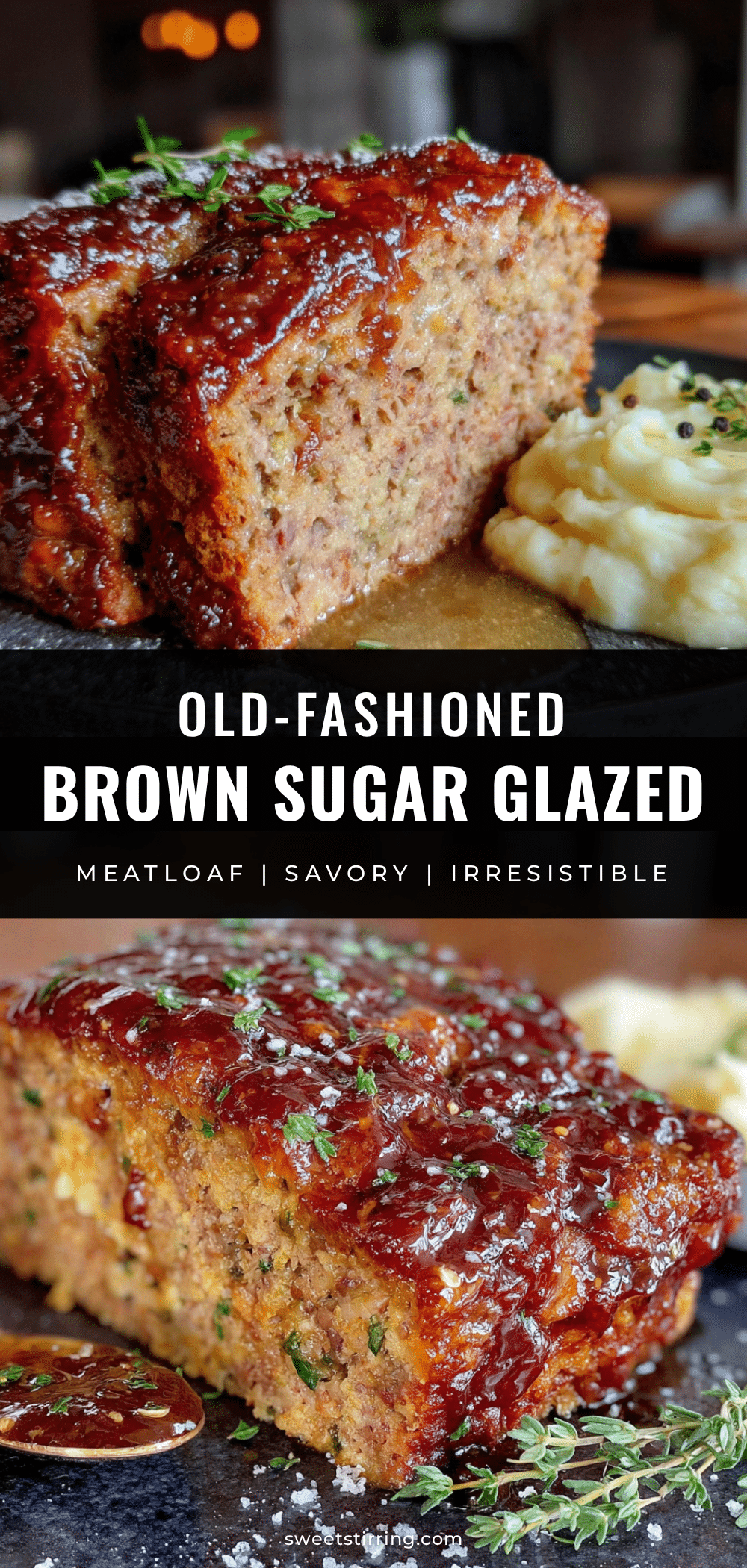
Classic Old-Fashioned Meatloaf with Brown Sugar Glaze
This classic old-fashioned meatloaf with brown sugar glaze is incredibly moist and tender, topped with a sticky, caramelized glaze that balances savory and sweet. It’s comfort food at its finest, perfect for family dinners or nostalgic cravings.
- Prep Time: 20 minutes
- Cook Time: 60-65 minutes
- Total Time: 80-85 minutes
- Yield: 8 servings 1x
- Category: Main Course
- Cuisine: American
Ingredients
- 2 pounds ground beef (80/20)
- 1/2 pound ground pork
- 1 medium yellow onion, grated
- 3 cloves garlic, minced
- 1 cup plain breadcrumbs (panko recommended)
- 1/2 cup whole milk
- 2 large eggs, lightly beaten
- 2 tablespoons Worcestershire sauce
- 1 tablespoon Dijon mustard
- 2 tablespoons fresh parsley, chopped
- 1 1/2 teaspoons kosher salt (or 1 teaspoon table salt)
- 1 teaspoon freshly ground black pepper
- 1/2 teaspoon dried thyme
- 1/2 cup ketchup (Heinz recommended)
- 1/4 cup packed brown sugar (light or dark)
- 1 tablespoon apple cider vinegar
- 1 teaspoon Worcestershire sauce
- 1/4 teaspoon garlic powder
Instructions
- Preheat oven to 350°F (175°C). Position rack in center. Line a baking sheet with aluminum foil.
- Make the panade: In a large mixing bowl, combine breadcrumbs and milk. Stir and let sit for 5 minutes until a paste forms.
- Grate the onion using the large holes of a box grater directly over the bowl with the panade. Add minced garlic.
- Add beaten eggs, 2 tablespoons Worcestershire sauce, and Dijon mustard. Whisk until well combined.
- Sprinkle in kosher salt, black pepper, dried thyme, and fresh parsley. Stir to distribute.
- Add ground beef and ground pork. Use your hands to gently mix until just combined (about 30 seconds). Do not overmix.
- Lightly grease a 9×5-inch loaf pan. Transfer meat mixture to pan and press gently into an even loaf shape. Place pan on prepared baking sheet.
- Make the glaze: In a small bowl, whisk together ketchup, brown sugar, apple cider vinegar, 1 teaspoon Worcestershire sauce, and garlic powder until smooth.
- Spread about half of the glaze evenly over the top of the meatloaf. Reserve remaining glaze.
- Bake for 45 minutes. Remove from oven and spread remaining glaze over top. Return to oven and bake for another 15-20 minutes.
- Check internal temperature with an instant-read thermometer; it should read 160°F (71°C) when done.
- Let meatloaf rest in the pan for 10 minutes. Then transfer to a cutting board.
- Slice into 1-inch thick slices and serve immediately.
Notes
Do not overmix the meat; mix gently with your hands until just combined. Let the meatloaf rest for 10 minutes before slicing to allow juices to redistribute. For best results, use a meat thermometer to ensure internal temperature reaches 160°F. The glaze will bubble over, so place the loaf pan on a lined baking sheet.
Nutrition
- Serving Size: 1 slice (1/8 of loaf
- Calories: 385
- Sugar: 11
- Sodium: 680
- Fat: 22
- Saturated Fat: 8
- Carbohydrates: 18
- Fiber: 1
- Protein: 28
Keywords: meatloaf, brown sugar glaze, classic meatloaf, comfort food, dinner, ground beef, ground pork